The story starts with an outpost that does not survive
The first defense we follow ends with 110 kills and a lost outpost. Later, the same recording shows a battered base still standing with 33 of 96 health remaining. That difference is the heart of this opening: the player does not simply need to destroy something. They need to keep something alive.
Horde Defenders, the Roblox game by Horizon Studios, places you between an outpost and an advancing alien-bug swarm. Its published premise is brief: aim your defenses, hold against the mass of enemies and progress through a campaign spanning five worlds. Much of the action is carried by what you do on the battlefield rather than by a detailed story synopsis.
This article follows the opening of Random Roblox Games R US’s September 28, 2026 recording as a small battle story. The events and result fields below come from selected saved frames; their meaning is our reading of those scenes. Official setting details were checked again on November 9. This is an older recorded playthrough, not a fresh test of the current game.
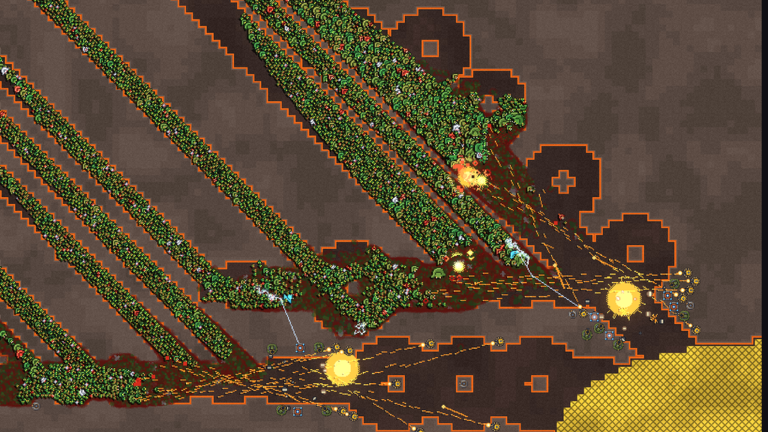
Official archival promotional image, credited to Horizon Studios / Roblox CDN. It establishes the battlefield setting; it is not the specific Level 1.1 attempt discussed below.
Before the swarm: two decisions where you expect one
September 28, 2026 creator recording. Selected saved frames were reread November 9; chapter links identify those scenes. This is not a review of every intervening action or a current-build playtest.
The YouTube player connects to Google when loaded. Your analytics choice does not control YouTube.
At 0:20, the tutorial points to grass beside a brown road and asks the player to place a Sentry. It is a small, clear task: put the defense in the marked area. The road leads towards the red-marked base area on the right. The quiet before the battle makes the arrangement easy to read.
At 0:26, the task changes. The Sentry is already there, but its target still needs to be moved onto the path. The white marker is not another building location; it is the place the tutorial wants the tower to aim. A few seconds later, the off-path warning makes the distinction explicit.
That is the opening’s first reversal. Placing a gun feels like securing a position, yet the position is unfinished until its fire is directed. The official description says towers fire where you aim them. In the tutorial, that rule becomes visible as a gap between having a defense and giving it a useful job.
For a viewer, the important object in this scene is therefore the target marker. Follow it from the tower to the road. The drama comes from a responsibility being handed to the player: the game is asking you to decide where the danger will be met.
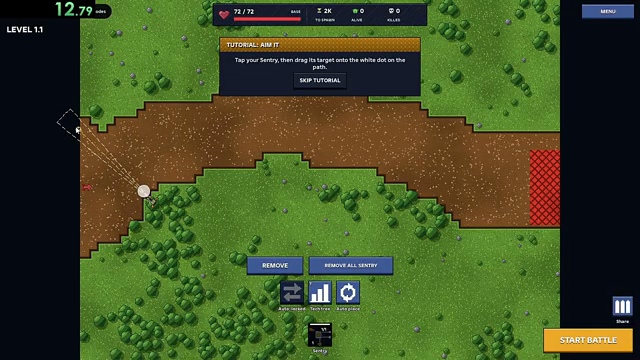
The 0:26 frame shows the placed Sentry and its separate target marker. The adjustment is in progress. Video by Random Roblox Games R US; saved frame reread November 9.
110 kills, zero base health: the first ending
At 0:51, the screen is crowded with enemies. The result panel records 110 kills, while the base-health display reads 0/72. The outcome is a loss. It is a stark image: the defense has done damage, but the place it was meant to protect has fallen.
The kill count makes the defeat more instructive than an empty battlefield would. Something worked enough to destroy enemies. It still was not enough to preserve the base. The scene separates activity from success, and gives the next attempt a question: how does this defense stop the route from becoming a route into the outpost?
The frame alone cannot identify the exact cause of every enemy getting through. It does not prove that one particular target position or upgrade caused the loss. What it does show is the consequence, with the result and the base health agreeing. That is a stronger starting point for the next decision than treating a busy firing lane as proof that the plan is sound.
The report leaves two immediate ways forward: retry, or inspect the Tech Tree. Defeat interrupts the battle but not the player’s work. The next scene is about deciding what to change.
The pause between attempts is part of the story
At 1:25, the recording is in the Sentry section of the Tech Tree. Instead of an advancing crowd, the screen presents branches and choices. The change of pace matters: the player has room to think about a defense after seeing where the battle ended.
The branches give different kinds of answers. Firepower concerns the strength of a bullet; firing rate concerns how often shots are produced; other branches concern reach or another Sentry placement. Those are different ways of changing the next attempt. Their practical details belong in the upgrade guide, but their place in this sequence is simple: the failure is followed by a decision, rather than an automatic victory.
We should not collapse the intervening attempts into “buy this and win.” The selected frames do not isolate one purchase as the cause of the later success. The more interesting progression is the player’s changing objective: from following a placement prompt to working out what a complete defense needs.
33 health left: an imperfect defense earns a way forward
At 6:02, the report is green. The base has 33/96 health, the result says it survived, and a Next Level button is available. The remaining health is low enough to make the result feel hard won, but it is still a different ending from the first screen’s zero.
This is the most satisfying turning point in the opening. The image does not require a perfect run to communicate progress. A damaged outpost can be a successful defense. The important change is that there is now something left to carry forward.
The screenshot also makes the choice visible: inspect the tree, build again or go to the next level. Survival opens the possibility of leaving. It does not force the player to leave. A player interested in a cleaner result can choose to stay with the same problem.
The maximum health has changed between the early loss and this later attempt. That is one reason not to turn these two scenes into a controlled test of a single tactic. As a sequence of outcomes, however, the contrast is clear: the first base is lost; the later one remains standing.
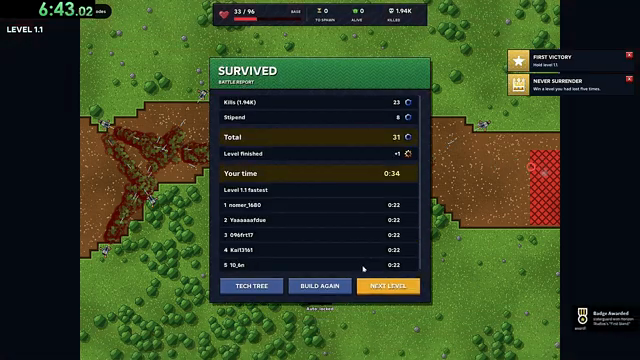
At 6:02, the saved creator-video frame shows 33/96 base health and Next Level available. The report’s 0:34 is this battle’s displayed time, not the time taken by all previous attempts.
The player stays: from surviving to keeping the base intact
The recording later returns to a Level 1.1 result. At 8:14, the base reads 108/108 and the report includes a Flawless line. This is another attempt, with a different maximum health. The result gives the opening a second kind of resolution: first the base survived, then a later defense ended at full displayed health.
The distinction changes the story’s stakes without inventing a new enemy or plot twist. The earlier success answered “can this outpost remain standing?” The later result answers a more demanding version of the question. For the viewer, it is an improvement in the outcome, not proof of a universal winning arrangement.
At 8:20, Level 1.2 is visible. The road now curves around a grassy island. The concrete transition is enough to end this first episode: the recording has moved beyond the opening level, and the new layout gives the next defense a different space to read.
The larger horizon: five worlds, with much still unnamed
The official game description advertises 59 levels across five alien worlds, with a boss in each. That gives the first outpost a larger context: the opening is one defense within a wider campaign. The description does not explain how travel between those worlds works or identify a final narrative outcome.
It is tempting to turn that outline into five named story chapters. The checked sources do not support doing so. What we can follow is the movement between actual level labels, layouts and results, as the recording does when it reaches 1.2. A new map provides a new situation; its number alone does not tell us what happened in the fiction.
For now, the campaign’s scale is clearer than its chronology. A verified map title or readable story panel would help fill in that chronology. Until then, the first defense is the part of this article we can tell in close detail.
Where the heroes fit into this defense
Horizon Studios names Warden, Marksman and Sentinel and describes a choice between letting heroes act on their own and taking direct control. Those options give the player another relationship with the battlefield: managing defenses from above or operating a hero.
The first Sentry sequence shows responsibility through a target marker. The hero premise offers a more direct form of participation. That comparison helps explain the game’s appeal, but it is not evidence that a named hero led this recorded opening or spoke during it. The selected scenes do not establish that.
No biography, rank or allegiance for those three characters is supplied by the official description checked here. Their names are useful identifiers for the hero guide; they are not enough to write a character history.
First Stand is a milestone; a challenge is a different promise
The official First Stand badge asks for survival at Level 1.1. That is a useful name for the opening’s central achievement: a place that was lost in an early attempt is still standing in a later one. Holding Ground supplies another named survival milestone at 3.1.
The same first level also has One Gun Wonder, which adds a one-tower restriction and rules out abilities. That describes a different task from ordinary survival. Its existence does not make the first successful clear incomplete; it offers another reason to revisit the battlefield.
These badge conditions give a playthrough goals we can name accurately. They do not turn optional restrictions into fictional events. A towerless challenge does not establish that the defenders canonically lost their equipment, just as a Flawless report does not reveal what happened after the battle.
What is known about the invasion—and what is not
The official premise establishes an alien-bug assault and an outpost to defend. It does not identify who sent the swarm, why the outpost was built, the heroes’ origins or the events after the final boss. The official game description and badge records rechecked on November 9 do not add those answers.
That leaves the setting open, but it does not leave this opening empty. We can see where the player places a defense, what they are asked to aim, how a first attempt ends and what a later survival makes possible. Those small, observable events give the battle its shape without needing an invented invasion history.
Continue from the moment the first outpost holds
The opening has a clear arc: a tower is placed, its aim becomes a separate problem, the first base falls, and a later attempt leaves enough health to continue. A further return produces a full-health result before the recording moves on. The progress is visible in the outcomes, even though these selected scenes cannot explain every decision between them.
If you are about to play, take one practical question from that arc: what part of your defense are you trying to improve on the next attempt? Follow the beginner guide for the controls, the result guide for what the ending means, or the Level 1.2 scene for what comes next. The first stand is a beginning worth understanding, not a claim that the rest of the campaign has already been explained.
Sources & limitations
Source dates are listed below. Developer descriptions can change during Alpha. These reference notes are not a report of an independent playtest.
- Random Roblox Games R US — recorded tutorial and tower panels Checked 2026-10-03. Selected level 1.1 tutorial, battle-result and Sentry/Howitzer panel scenes. The description links the exact Roblox experience. This recording predates the September 29 game update; it is not an independent current-build playtest, a complete upgrade catalogue or a guaranteed winning build.
- Horde Defenders — official premise rechecked November 9 Checked 2026-11-09. HTTP 200 for universe 10766114988 / place 93237333081860, Horizon Studios group 15014131. Description still supplies manual aiming, alien bugs/outpost, named hero control options and 59 levels / five worlds / boss per world. Game update timestamp remains October 6. No named-world chronology, invasion origin, hero biography or ending is supplied.
- Horde Defenders — official badge conditions rechecked November 9 Checked 2026-11-09. HTTP 200; six enabled badges for the exact universe. Conditions unchanged from October 30. First Stand, Holding Ground and One Gun Wonder support the article’s named objectives, not fictional chronology.
- Random Roblox Games R US — opening battle story, saved frames reread November 9 Checked 2026-11-09. Visually reread saved frames at 0:20, 0:26, 0:34, 0:51, 1:25, 6:02, 8:14 and 8:20. Confirms marked placement, separate aim marker and off-path warning, LOST with 110 kills and 0/72 health, the four Sentry branch labels, later SURVIVED with 33/96 and Next Level, subsequent 108/108 with Flawless line, and Level 1.2 road around grass. No fresh playback, complete intervening action review, current-build playtest or causal winning strategy is claimed.